
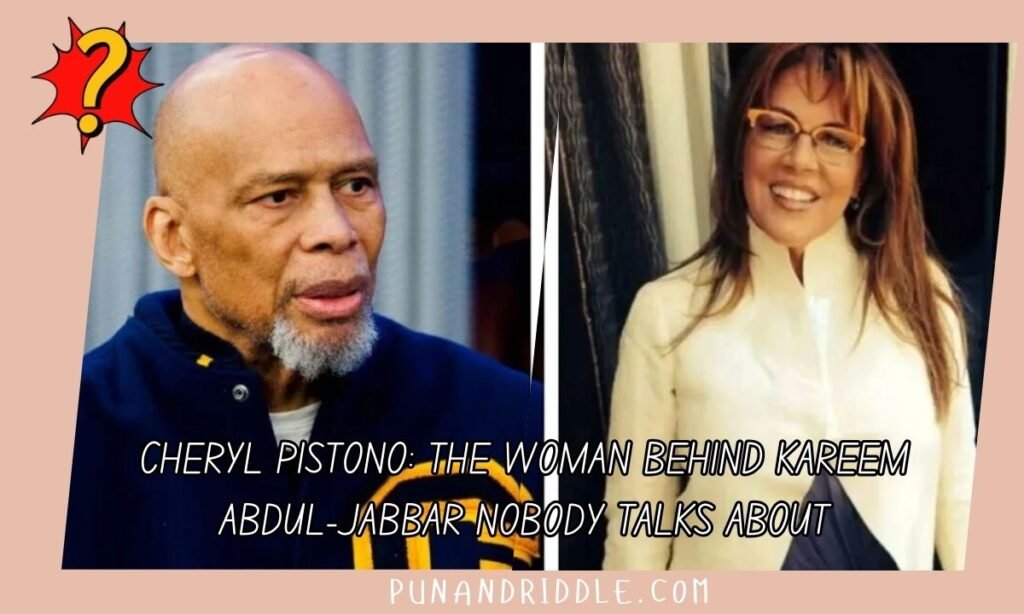
She never played a single game. She never gave a single interview. Yet Cheryl Pistono shaped one of the most legendary careers in basketball history from the shadows. You know Kareem Abdul-Jabbar. But do you really know the woman who helped make him who he became off the court? Her story is more interesting than most people realize.
Who Is Cheryl Pistono?
Early Life in LaSalle, Illinois
Cheryl Pistono was born on March 14, 1956, in LaSalle, Illinois. LaSalle sits along the Illinois River, a quiet Midwestern town where community values run deep. She grew up in a traditional Catholic household that emphasized faith, education, and service.
From early on, she showed intellectual curiosity that went beyond what her environment expected of her. She questioned organized religion while holding onto its moral core. She was not rebellious for the sake of it and genuinely searching for answers.
Friends from those years described her as determined and fiercely independent. She didn’t follow conventional paths simply because they were available. That mindset shaped everything that came after.
Her Move West and Political Awakening
In her early 20s, Cheryl left Illinois and headed to California. The West Coast in the late 1970s was electric with social change. Women’s rights, activism, and counter-cultural thinking were everywhere.
She threw herself into women’s rights advocacy and community organizing during this period. She believed in equality not as an abstract idea but as something worth fighting for in real, practical ways. This wasn’t a phase. It became the foundation of her identity.
By the time she crossed paths with Kareem Abdul-Jabbar, Cheryl had already built a sense of self that had nothing to do with basketball or celebrity. That independence is exactly what made her stand out.
Cheryl Pistono Quick Bio Table
| Attribute | Details |
| Full Name | Cheryl Lynn Pistono |
| Date of Birth | March 14, 1956 |
| Birthplace | LaSalle, Illinois, USA |
| Nationality | American |
| Known For | Former partner of Kareem Abdul-Jabbar |
| Children | Amir Abdul-Jabbar (son) |
| Husband | Steven Jenkins (married 1985) |
| Profession | Business consultant, political activist |
| Residence | California |
| Philosophy | Humanism, intellectual independence, women’s empowerment |
How Cheryl Pistono Met Kareem Abdul-Jabbar
Los Angeles in the Late 1970s
When Cheryl arrived in Los Angeles, Kareem Abdul-Jabbar was at the height of his NBA career. He had won multiple MVP awards, converted to Islam, and was one of the most recognized athletes on the planet. He was also navigating a very turbulent personal life.
Their meeting wasn’t a headline-making event. They connected through shared intellectual interests. Both cared about social justice. Both were interested in philosophy and meaning beyond what society handed them. That common ground mattered more than his fame.
Cheryl engaged him as an equal from the start. She wasn’t starstruck. She pushed back on his ideas and offered perspectives he hadn’t encountered. For someone as guarded as Kareem reportedly was in those years, that kind of honest engagement was rare and valuable.
What Made Their Connection Different
Most relationships around professional athletes in that era revolved around celebrity culture. Cheryl wasn’t interested in that. She brought intellectual depth and emotional honesty to the relationship.
She was also genuinely curious about his spiritual journey. Kareem had converted to Sunni Islam in 1968 and was still working through what that meant for his life. Cheryl didn’t share his faith, but she respected his path and engaged seriously with the questions he was exploring.
That willingness to discuss faith, philosophy, and purpose without judgment created something real between them. Their bond grew from genuine compatibility, not proximity to fame.
The Nature of Their Relationship
A Partnership Built on Mutual Respect
Cheryl and Kareem never married. That was a deliberate choice. Both believed in defining relationships on their own terms rather than following social scripts about what commitment should look like.
Their relationship lasted through the late 1970s and into the early 1980s. Throughout that time, she maintained her own identity, her own work, and her own social circle. She never became an appendage to his celebrity.
Those who knew them describe the relationship as one of equals. Kareem respected her opinions. She challenged his thinking. The dynamic was intellectually alive in a way that clearly meant something to both of them.
The Interfaith Dimension
Cheryl was raised Catholic. Kareem had converted to Islam. On paper, that’s a significant religious gap. In practice, it became one of the most intellectually rich aspects of their connection.
They talked seriously about faith, doctrine, humanism, and what religion actually means in a person’s daily life. Neither tried to convert the other. They were more interested in understanding than in winning arguments.
This interfaith dynamic gave their relationship a depth that purely secular or purely religious relationships often lack. Both grew from it.
Cheryl Pistono and Motherhood
Amir Abdul-Jabbar’s Birth
In 1981, Cheryl gave birth to Amir Abdul-Jabbar. That event shifted everything. Motherhood became her primary focus, and she approached it with the same intensity she brought to her activism.
She wanted Amir to grow up grounded. Not sheltered from reality, but grounded in real values. Education mattered. Character mattered. The fact that his father was a basketball legend was just a fact about their lives, not a defining feature of Amir’s identity.
Cheryl shielded him from excessive media attention throughout his childhood. She wanted him to develop on his own terms, free from the weight of his father’s extraordinary reputation.
Co-Parenting with Kareem
When the romantic relationship ended, the parenting relationship didn’t. Cheryl and Kareem maintained open communication and a cooperative approach to raising Amir. That kind of maturity is genuinely rare.
Both parents emphasized education and intellectual curiosity. Both instilled a sense of social responsibility. They kept their differences private and presented a united front for their son.
Amir went on to become an orthopedic surgeon. That outcome doesn’t happen without intentional, sustained effort from both parents. Cheryl’s steadiness, focus, and refusal to let celebrity culture define their home environment was central to that success.
Cheryl Pistono’s Marriage to Steven Jenkins
A New Chapter After Kareem
In 1985, Cheryl married Steven Jenkins. This marked a clean, deliberate turn toward a private life. She stepped away from public view and focused on building a stable family environment.
Her marriage to Jenkins reflected the same values that characterized her entire adult life: commitment, loyalty, and privacy. She chose depth over visibility, again.
The marriage has lasted, which in itself says something about the kind of person Cheryl is. She doesn’t make commitments carelessly, and she doesn’t abandon them when they get hard.
Family Life and Lasting Priorities
After her marriage, Cheryl’s involvement with Kareem’s public world faded almost entirely. She appeared occasionally at key milestones but gave no interviews and sought no attention.
Her focus was on her family. Raising Amir, supporting her husband, and continuing her community work in California. Those priorities never changed. They’ve been consistent across four decades.
People who’ve met her in recent years describe someone who is deeply present, thoughtful, and genuinely unconcerned with how the world perceives her. That kind of psychological stability is hard to come by.
Cheryl Pistono’s Professional Career
Business Consulting and Private Equity
Contrary to the assumption that she disappeared after her relationship with Kareem ended, Cheryl built a real professional career. She worked as a business consultant, advising private equity firms in the wellness and education sectors.
This work suited her perfectly. It required sharp analytical thinking, discretion, and the ability to operate without public recognition. She excelled in boardrooms far removed from basketball courts or celebrity culture.
Her professional reputation was built on merit, not on her connection to Kareem. That mattered to her. She wanted to be valued for what she actually contributed, not for who she once dated.
Advocacy Work and Women’s Rights
Through the 1980s and 1990s, Cheryl stayed deeply involved in women’s rights organizations. She worked behind the scenes on strategy, advocacy, and community initiatives in California.
She preferred substance over recognition and mentored younger women entering business and advocacy, sharing what she had learned without seeking credit for it. That kind of quiet mentorship shapes careers even when it never makes the news.
Her commitment to women’s empowerment wasn’t rhetorical. It showed up in how she spent her time and energy over decades.
Her Philosophy and Beliefs
Humanism at the Core
Cheryl’s worldview centers on humanism. She believes in human potential, rational thinking, and the capacity for growth without institutional religion as a guide. Her Catholic upbringing gave her a moral framework. She evolved beyond its doctrinal boundaries while keeping its ethical spirit.
She believes education is liberation. That idea shaped everything from her advocacy work to how she raised her son. Access to knowledge and critical thinking skills give people real freedom.
Her approach to belief is also notable for what it lacks: dogma. She holds her views with intellectual honesty, remaining open to challenge and revision. That’s rare in people whose values run as deep as hers clearly do.
Privacy as a Principled Choice
Cheryl’s decision to stay out of the spotlight wasn’t timidity. It was a philosophical stance. She understood early that media attention distorts people. It flattens complexity and rewards performance over substance.
She chose to protect her complexity by staying private. That meant her actual influence operated through relationships, conversations, and work rather than through public image management.
In a culture that increasingly mistakes visibility for significance, that choice looks more principled with every passing year.
Cheryl Pistono’s Influence on Kareem Abdul-Jabbar
Personal Growth During a Critical Period
Kareem Abdul-Jabbar’s personal evolution during the late 1970s and early 1980s was significant. His social justice views deepened. His relationship with fatherhood developed. And His sense of identity outside basketball took shape.
Cheryl was present for all of it. Those who knew them both credit her with pushing his thinking and providing the kind of honest intellectual feedback he didn’t get from most people around him. She had no interest in flattering him or managing his ego. She engaged him seriously.
That kind of relationship changes people. The evidence is in Kareem’s own writings, which consistently reflect a man who grew significantly during that period of his life.
Fatherhood and Legacy
Kareem has acknowledged the important relationships in his life in various memoirs and public reflections. He respects privacy enough not to detail every personal connection. But the influence of that period on his evolution as a father and as a public intellectual is documented.
Cheryl helped ground him during a time when his professional success could easily have consumed his personal development. She modeled what it looked like to live with integrity and clarity. That modeled behavior leaves marks.
Their shared success in raising Amir, a man who built his own identity entirely separate from his father’s fame, is the clearest evidence of what that partnership produced.
Where Is Cheryl Pistono Today?
Life in California, 2025
As of 2025, Cheryl Pistono is 69 years old and lives in California. She maintains the low profile she has always preferred. While She participates in local community initiatives, continues selective consulting work, and stays connected to causes around education and women’s empowerment.
She is not on social media. She doesn’t give interviews and attend events to be photographed. Those who have met her in recent years consistently describe someone who is sharp, kind, and completely at ease with her own irrelevance to celebrity culture.
Her son Amir has built a successful career as an orthopedic surgeon. Her marriage to Steven Jenkins continues. The priorities she set decades ago remain intact.
Her Relationship with Kareem Today
By all accounts, the relationship between Cheryl and Kareem remains cordial and respectful. They share a son, and co-parenting that relationship successfully over four decades required sustained mutual respect on both sides.
Neither has spoken negatively about the other publicly. That restraint, across decades of separation, reflects the character of both people. It also reflects something Cheryl modeled consistently throughout her life: dignity is not something you perform for an audience. It’s something you practice in private.
Legacy and Public Perception
What Her Life Actually Represents
Cheryl Pistono’s legacy is not about being connected to Kareem Abdul-Jabbar. It’s about what she chose to do with her own life when that connection could have defined everything.
She could have leveraged his fame for interviews, book deals, or public attention. She could have let his celebrity shape her identity. And She built something real, quiet, and lasting on her own terms.
- She raised a son who became a surgeon.
- She built a professional career based on merit.
- She maintained a 40-year marriage.
- She contributed to women’s rights advocacy for decades.
- She kept her integrity intact through all of it.
That is the actual record. It doesn’t fit neatly into a celebrity narrative. That’s exactly the point.
Why Her Story Matters Now
In 2025, the culture’s relationship with privacy and celebrity has only gotten more complicated. Everyone is expected to share everything. Authenticity is performed for algorithms. Identity is managed for audiences.
Cheryl Pistono spent her entire adult life doing the opposite. She protected her inner life fiercely. She let her actual choices, over decades, define who she was. That approach looks more radical now than it did in 1980.
Her story is a useful reminder that significance and visibility are not the same thing. Plenty of people have made real differences in the lives around them without anyone writing articles about it. Cheryl is one of them.
Frequently Asked Questions
Who is Cheryl Pistono?
She is a businesswoman, political activist, and the former partner of NBA legend Kareem Abdul-Jabbar.
Was Cheryl Pistono married to Kareem Abdul-Jabbar?
No. They had a committed relationship but never married.
Who did Cheryl Pistono marry?
She married Steven Jenkins in 1985.
Does Cheryl Pistono have children?
Yes. She has a son, Amir Abdul-Jabbar, born in 1981.
What does Amir Abdul-Jabbar do now?
He is an orthopedic surgeon.
Where is Cheryl Pistono today?
She lives in California and maintains a private, low-profile lifestyle.
What did Cheryl Pistono do professionally?
She worked as a business consultant advising private equity firms in wellness and education.
How did Cheryl Pistono influence Kareem Abdul-Jabbar?
She challenged his thinking, deepened his social justice views, and helped shape his approach to fatherhood during a critical period of his life.
What is Cheryl Pistono’s philosophy?
She holds humanist values centered on education, intellectual independence, and women’s empowerment.
Why did Cheryl Pistono avoid the spotlight?
It was a principled choice. She believed her identity should stand on its own, not on her proximity to celebrity.
Is Cheryl Pistono still in contact with Kareem Abdul-Jabbar?
They share a son and maintain a cordial, respectful relationship.
What is Cheryl Pistono’s lasting legacy?
Raising a successful son, building a career on merit, and living with consistent integrity while resisting the pull of celebrity culture.
Conclusion
Cheryl Pistono’s life resists easy summary. She was a Catholic girl from Illinois who became a women’s rights advocate, a business consultant, the partner of one of basketball’s greatest players, a devoted mother, and a loyal wife.
She did all of that while carefully guarding her private life from public consumption. What makes her story worth knowing isn’t the Kareem connection. It’s the consistency.
Across decades and very different circumstances, she remained the same person. Principled. Curious. Committed to substance over performance. That kind of integrity is harder to maintain than it looks. Cheryl Pistono maintained it for a lifetime.

Shoaib is a creative writer who loves clever wordplay and brain teasers, sharing fun puns and riddles that spark laughter, curiosity, and smart thinking for readers worldwide.