
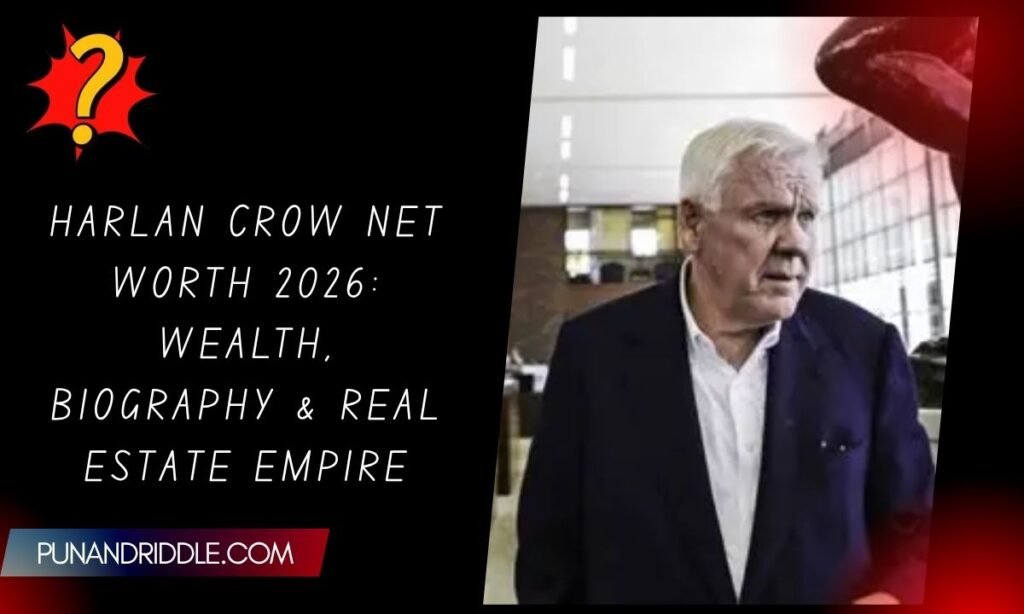
Harlan Crow is one of the most talked-about billionaires in America right now. His fortune sits at an estimated $2.5 to $3.1 billion in 2026, built on decades of real estate. But his money is only part of the story.
Harlan Crow Biography at a Glance
| Detail | Information |
| Full Name | Harlan Rogers Crow |
| Date of Birth | November 28, 1949 |
| Age (2026) | 77 years old |
| Birthplace | Dallas, Texas |
| Education | BBA, University of Texas |
| Company | Crow Holdings (CEO & Chairman) |
| Father | Trammell Crow |
| Spouse | Kathy Crow |
| Children | Sarah, Rob, Jack |
| Net Worth (2026) | $2.5B – $3.1B |
Who Is Harlan Crow?
Harlan Rogers Crow is an American real estate developer, investor, and the chairman and CEO of Crow Holdings, a Dallas-based private investment firm. He inherited a powerful business foundation from his father, Trammell Crow, and turned it into one of the largest real estate empires in the country.
Born on November 28, 1949, in Dallas, Texas, Crow grew up watching his father build what would become America’s largest private real estate development company. That upbringing shaped everything about how he runs his business today.
Harlan Crow Net Worth in 2026
The most widely cited estimate puts Harlan Crow’s net worth at $2.5 billion to $3.1 billion in 2026. Different sources land at different numbers, and that’s partly because Crow Holdings manages a much larger pool of assets — estimated at $29 billion to $33 billion — that includes outside investor capital. Not all of that belongs to Crow personally.
His personal wealth comes primarily from his ownership stake in Crow Holdings, long-term commercial real estate holdings, and a collection of luxury assets.
| Wealth Metric | Estimated Figure |
| Personal Net Worth (2026) | $2.5B – $3.1B |
| Crow Holdings AUM | ~$29B – $33B |
| Annual Revenue (Holdings) | ~$1B |
| Dallas Mansion | ~$50M – $55M |
| Yacht (Michaela Rose) | ~$500M estimated |
How Harlan Crow Built His Fortune
Crow didn’t start from zero. But he also didn’t coast on his father’s name. He spent years learning the business from the ground up before taking the helm.
Starting Out at Trammell Crow Company
Crow started as a leasing agent at his father’s firm between 1974 and 1978. He spent those early years learning property management and client relationships. It wasn’t a glamorous start, but it gave him a practical education in how real estate actually works.
From 1978 to 1986, he ran Dallas Office Building Management. He supervised multiple commercial properties, developed expansion strategies, and built the operational instincts he’d rely on for the rest of his career. By 1988, he was named CEO and chairman of Crow Holdings.
Building Crow Holdings
Crow Holdings is the engine behind his wealth. Under Harlan’s leadership, the company expanded well beyond its original Dallas commercial real estate focus.
It now manages assets across office buildings, retail centers, industrial properties, multifamily housing, and hospitality. The firm has a reputation for patient, long-term capital deployment.
Crow Holdings identifies undervalued properties, develops or repositions them, and holds them for sustained returns. That strategy has worked consistently for over five decades.
Crow Holdings: The Core of His Empire
Crow Holdings is the umbrella organization managing the family’s business operations. Harlan took over as CEO and chairman in 1988 and has guided the company’s growth ever since. Annual revenues are estimated near $1 billion across diversified holdings.
The company manages real estate across multiple sectors and cities, employing hundreds of professionals. It remains one of the most prominent private real estate firms in the United States.
Key Business Segments
Crow Holdings operates across several verticals. Commercial properties — including office buildings and shopping centers — form the core. The company also has significant residential development operations, including multifamily and single-family projects.
The hospitality segment includes hotels and resort investments. The Dallas Market Centre and Atlanta’s Peachtree Centre are among the most recognizable legacy assets tied to the broader Crow family business history.
Harlan Crow’s Luxury Assets
Beyond business holdings, Crow owns several high-profile personal assets. His primary residence is a 30,000-square-foot estate in Highland Park, Dallas, valued at roughly $50 to $55 million. The property includes a private library that houses rare historical documents, a championship golf course, a pool, and a tennis court.
He also owns the Michaela Rose, a 161-foot private yacht built in 1984 by Fr. Schweers Shipyard in Germany. The vessel accommodates twelve guests and operates with a crew of thirteen. It was comprehensively renovated in 2008.
Harlan Crow’s Art and Memorabilia Collection
Crow is an avid collector of art and historical artifacts. His estate features works by Renoir and Monet. He also owns Winston Churchill’s watercolors and books from Napoleon’s personal library.
More controversially, his collection includes a signed copy of Mein Kampf, paintings by Adolf Hitler, and a sculpture garden featuring statues of Joseph Stalin, Mao Zedong, and Vladimir Lenin.
Crow has described these items as historical artifacts rather than endorsements, telling Forbes: “This is history, and it is history that is changing before our eyes.”
Harlan Crow’s Political Donations
Crow and his wife Kathy have been major conservative donors for decades. According to Open Secrets, the couple donated at least $14.7 million to political candidates, committees, and parties over roughly 30 years. More than $7.6 million of that came after the start of the 2016 election cycle.
He has also contributed to organizations that don’t publicly disclose donors, which means the full scope of his political giving isn’t publicly known.
Harlan Crow and Clarence Thomas Controversy
The most significant public controversy surrounding Crow involves his long friendship with Supreme Court Justice Clarence Thomas. ProPublica reported in 2023 that Crow had been funding luxury travel for Thomas for decades — private jets, yacht trips, resort stays — without Thomas disclosing them in mandatory financial filings.
Thomas later amended his disclosures, explaining that his peers had told him the trips didn’t need to be reported because Crow had no cases before the court. Legal ethics experts consulted by ProPublica disagreed with that interpretation.
What Was Actually Disclosed
Thomas’s amended disclosures confirmed trips to an Indonesian island and to an exclusive all-male club in the Northern California redwoods, both paid for by Crow. He also regularly used Crow’s private jet and visited Crow’s private resort in the Adirondacks.
Crow also donated $19,000 in scripture books to Thomas and contributed $105,000 to Yale’s Clarence Thomas Institute for constitutional law. The relationship has been described by multiple outlets as among the most scrutinized friendships in recent Supreme Court history.
Why It Matters
The issue isn’t just about gifts — it’s about disclosure requirements and whether a justice can accept substantial benefits from someone with ideological and political interests.
Thomas and Crow share conservative philosophies, and that alignment has drawn sustained attention from ethics watchdogs, lawmakers, and legal scholars.
The controversy remains unresolved. No formal sanctions have been imposed on Thomas, but the scrutiny prompted broader discussions about Supreme Court ethics reform.
Harlan Crow’s Family Background
Crow grew up the third of six children in a prominent Dallas family. His father, Trammell Crow, built what was once the largest private real estate development company in the United States. His mother, Margaret Doggett Crow, was known for her charitable work and instilled values of community service in her children.
Harlan’s father was responsible for landmark developments including the Peachtree Center in Atlanta and the Embarcadero Center in San Francisco. The Crow name was synonymous with American commercial real estate long before Harlan took the reins.
Harlan Crow’s Education
Crow attended Randolph-Macon Academy in Virginia before studying at Emory University in Atlanta. He earned his Bachelor of Business Administration from the University of Texas, where he focused on finance and management. Those academic connections gave him an early network of future business peers and mentors.
Harlan Crow’s Philanthropy
Crow has been a consistent supporter of cultural institutions in Dallas. His donations include ongoing support for the Dallas Museum of Art, the Dallas Symphony Orchestra, the Nasher Sculpture Center, and the Dallas Zoo. He has also supported healthcare initiatives, including contributions to the Methodist Dallas Medical Center.
His philanthropic activity reflects both personal interests — particularly in art and history — and a broader commitment to the city of Dallas, where his family’s legacy is deeply embedded.
Frequently Asked Questions
What is Harlan Crow’s net worth in 2026?
Estimates range from $2.5 billion to $3.1 billion, based on his stake in Crow Holdings and real estate assets.
How did Harlan Crow make his money?
He built his wealth through Crow Holdings, a private real estate firm he inherited and expanded from his father Trammell Crow.
What is Crow Holdings?
Crow Holdings is a Dallas-based private investment firm managing an estimated $29 to $33 billion in real estate assets across commercial, residential, and hospitality sectors.
Why is Harlan Crow controversial?
He has faced scrutiny for funding decades of undisclosed luxury travel for Supreme Court Justice Clarence Thomas, raising ethics questions about judicial gift disclosure rules.
How much has Harlan Crow donated politically?
Open Secrets documented at least $14.7 million in political donations over roughly 30 years, primarily to Republican candidates and committees, with additional undisclosed contributions.
Conclusion
Harlan Crow’s $2.5 to $3.1 billion net worth in 2026 reflects a lifetime of building on a powerful inheritance and expanding it through disciplined real estate strategy.
His business legacy is substantial, but his name has become equally tied to political controversies and ethical questions about his relationship with Clarence Thomas. Understanding his wealth means looking at both sides of that story.

Shoaib is a creative writer who loves clever wordplay and brain teasers, sharing fun puns and riddles that spark laughter, curiosity, and smart thinking for readers worldwide.